
By Michael Fryar
General information, not legal advice. This article (written in 2025) explains how Connecticut conservatorship generally works. It isn't legal advice, and reading it doesn't create an attorney-client relationship. Don't rely on it for any decision. Laws, court forms, benefit rules and dollar figures change, and some details here may be out of date or simplified. Verify current law, forms and figures with the Probate Court, the Department of Social Services (DSS), the Social Security Administration (SSA) and the Centers for Medicare & Medicaid Services (CMS), and talk with a Connecticut attorney about your own situation. The concepts matter more than the specifics. I wrote this in my personal capacity, based on my private law practice. The views are my own and don't represent any government agency.
Contents
- Why this matters
- Part 1: The legal framework
- Part 2: Odd isn't dangerous: why you can't hospitalize someone just for being strange
- Part 3: What to do after the appointment: the first six months
- Part 4: Medicare
- Part 5: Medicaid (HUSKY C) and the application
- Part 6: Social Security representative payee, briefly
- Part 7: The Heart of the Interview: Interviewing Dual-Diagnosed, At-Risk Clients
- Appendix: Sample Forms and Letters
Why this matters
A conservatorship is one of the most serious things a court can do to an adult who hasn't committed a crime. The court gives another person the power to decide where someone lives, what medical care they get, or how their money is spent. When it's done well, it keeps a vulnerable person housed, insured, fed and safe. When it's done carelessly, it strips away rights the person could have kept. This guide covers both sides: what the law requires, and what a new conservator actually has to do once the judge signs the decree.
Part 1: The legal framework
Where the law lives
Connecticut's conservatorship statutes start at General Statutes § 45a-644 (definitions) and run through § 45a-663, in Chapter 802h, "Protected Persons and Their Property" (cga.ct.gov, Chapter 802h (www.cga.ct.gov/current/pub/chap_802h.htm)). The cases are heard in the Probate Courts. The Probate Court system publishes forms and plain-language guides at ctprobate.gov. The Probate Court forms cited in this article (PC-370, PC-371, PC-441, PC-442) are posted there too.
The law draws a basic line between two kinds of help:
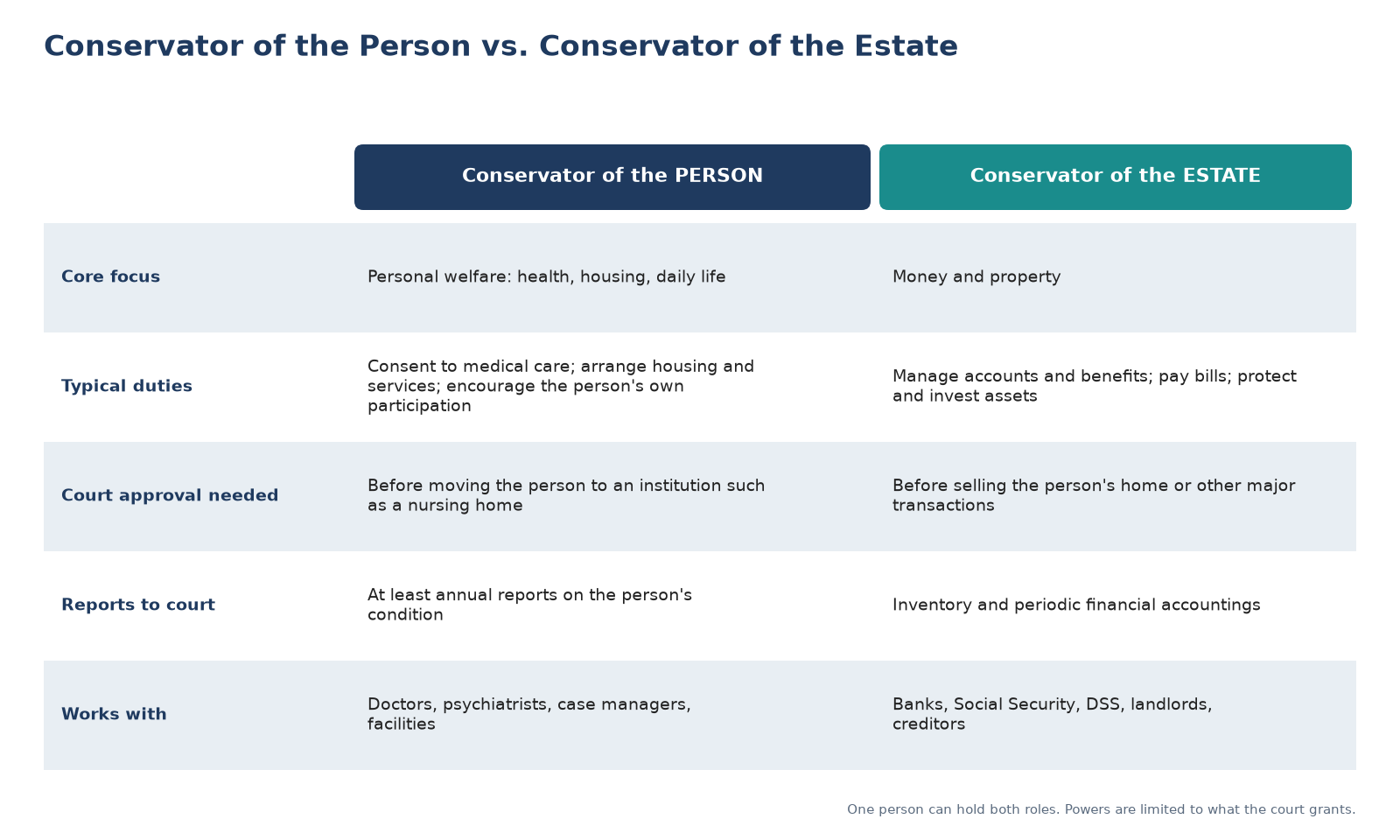
- A conservator of the person handles personal decisions: medical care, housing, and day-to-day welfare. The statute calls this being "incapable of caring for one's self": a mental, emotional or physical condition that leaves the person "unable to receive and evaluate information or make or communicate decisions to such an extent that the person is unable, even with appropriate assistance, to meet essential requirements for personal needs" (§ 45a-644(c)).
- A conservator of the estate handles money and property: bank accounts, investments, benefits and real estate. The statute calls this being "incapable of managing his or her affairs": the same kind of condition leaves the person unable, "even with appropriate assistance, to perform the functions inherent in managing his or her affairs," and either the person's property "will be wasted or dissipated unless adequate property management is provided" or funds are needed for the person's support and the person can't take the steps to obtain them (§ 45a-644(d)).
One person can serve in both roles, or the court can split them. In practice, the person side covers medical decisions, housing, and (with court permission) placement in a nursing home. The estate side means securing and protecting the person's assets, and getting court permission before selling most kinds of property. That includes property sold as part of a Medicaid spend-down.
Voluntary versus involuntary
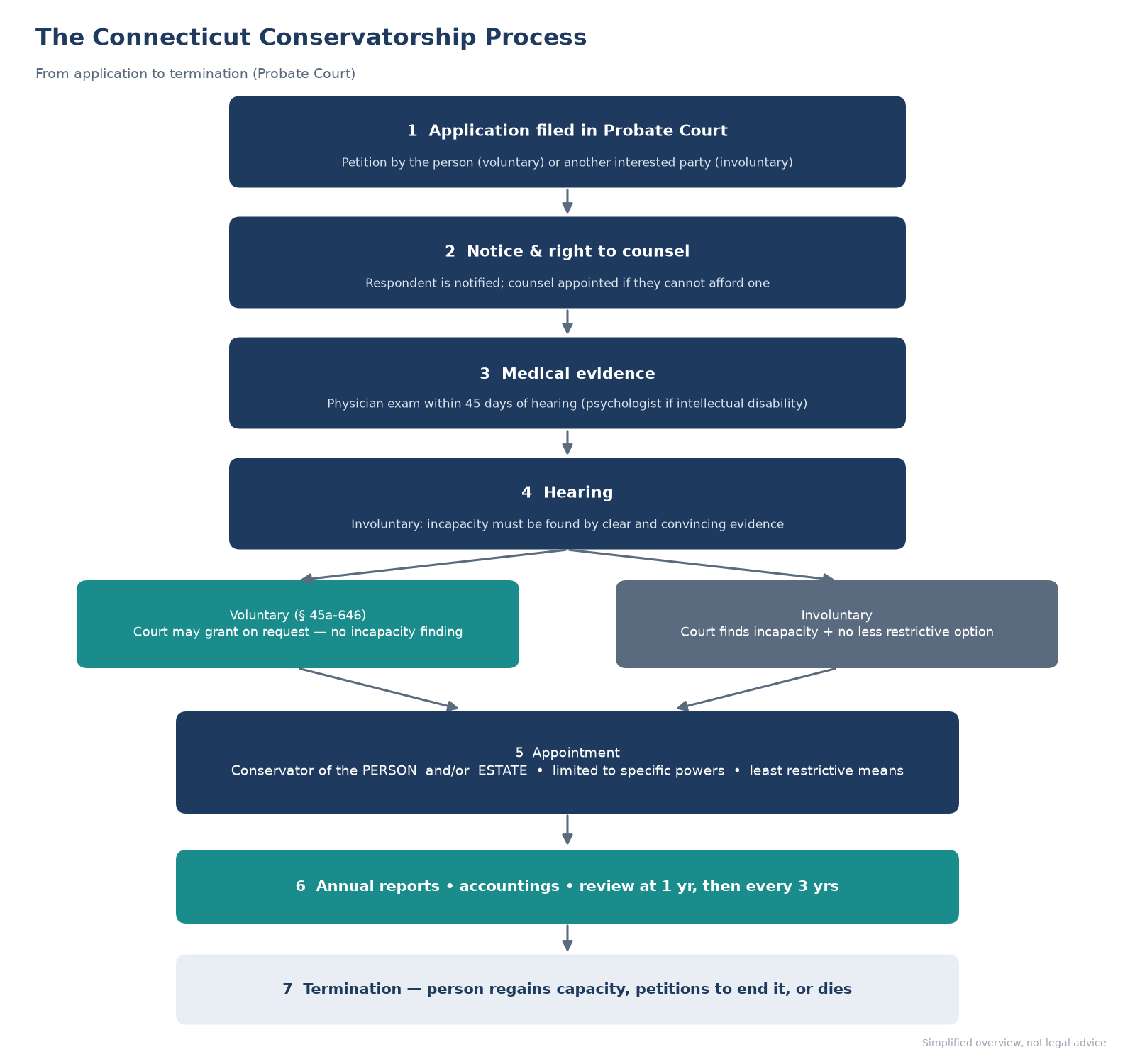
Voluntary representation (§ 45a-646). An adult can ask the Probate Court to appoint a conservator for them. The court can grant the request without finding that the person is incapable. In my experience, when a physician or psychologist's evaluation supports the need, the court will often offer the voluntary route first if the person agrees to it. Getting out is simple: under § 45a-647, a person under voluntary representation "shall be released from voluntary representation upon giving thirty days' written notice to the Court of Probate." If others believe the person still needs protection, their remedy is a separate application for involuntary representation.
Involuntary representation (§ 45a-648 and following). If the person doesn't agree, someone else can file an application. Connecticut takes false applications seriously: § 45a-648 makes a fraudulent or malicious application, or false testimony, a Class D felony (Chapter 802h table of sections (www.cga.ct.gov/current/pub/chap_802h.htm)). Ending an involuntary conservatorship takes a court order. The conserved person can petition at any time; the petition is decided by a preponderance of the evidence, and the statute says the person "shall not be required to present medical evidence" (§ 45a-660(a)(1)). In practice, supporting evidence that the person can manage again still helps.
The respondent's rights
The person the petition is about, called the respondent, has real procedural protections:
- Notice. Section 45a-649 requires notice of the application.
- A lawyer. Section 45a-649a gives the respondent a right to an attorney in involuntary proceedings, and provides for counsel when the person is indigent.
- A recorded hearing (§ 45a-645a), with the rules of evidence applied (§ 45a-645b), scheduled so the respondent can attend (§ 45a-645c).
- Medical evidence. Under § 45a-650, the court has to receive evidence about the respondent's condition from "one or more physicians licensed to practice medicine in this state who have examined the respondent not more than forty-five days prior to the hearing." For a person with intellectual disability, a licensed psychologist's evidence may be used instead. The court may waive medical evidence only if it is impossible to obtain (for example, the respondent refuses to be examined) or the alleged incapacity is not medical in nature, and it must state why in the decree (§ 45a-650(c)).
- Clear and convincing evidence. Before appointing a conservator involuntarily, the court must find by clear and convincing evidence that the respondent is incapable of caring for himself or herself (or of managing his or her affairs), that the respondent "cannot be cared for adequately without the appointment of a conservator," and that the appointment "is the least restrictive means of intervention available" (§ 45a-650(f)). The court must also weigh nine listed factors, including the person's preferences, cultural background, and any existing power of attorney or health care representative (§ 45a-650(g)).
These are the section titles in the official chapter listing (cga.ct.gov). Readers should check the full text, including the most recent supplement, for any later amendments.
The 2007 reform and "least restrictive means"
Public Act 07-116 overhauled Connecticut conservatorship law. The official statute history notes cite it throughout Chapter 802h. For example, it added the term "conserved person" in place of older language (§ 45a-593 and § 45a-595 history notes (www.cga.ct.gov/current/pub/chap_802h.htm)). The reform's central idea was that a conservatorship should take away as little independence as possible. The court has to consider less restrictive alternatives, such as a power of attorney, a health care representative, supported decision-making or a representative payee. If a conservator is needed, the court should give that person only the powers the situation calls for. That's called a limited conservatorship, and it's meant to be the starting point, not the exception. The statute defines "least restrictive means of intervention" as intervention "sufficient to provide, within the resources available to the conserved person . . . for a conserved person's personal needs or property management while affording the conserved person the greatest amount of independence and self-determination" (§ 45a-644(k)). The court "shall assign to a conservator . . . only the duties and authority that are the least restrictive means of intervention necessary," and must find by clear and convincing evidence the need for each duty assigned (§ 45a-650(m)). The conserved person keeps "all rights and authority not expressly assigned to the conservator" (§ 45a-650(l)).
Duties, reports and accountings
- A conservator of the estate (§ 45a-655) manages and protects the property. That means filing an inventory, at fair market value, within two months of appointment (§ 45a-655(a)) and accountings when required; the court may, and on request of any interested party shall, require annual accountings (§ 45a-655(c)). Court approval is needed before selling the person's real property or household furnishings (§ 45a-656b).
- A conservator of the person (§ 45a-656) handles personal needs, encourages the person's own participation in decisions, and "shall report at least annually" to the Probate Court on the person's condition, efforts to encourage independence, and whether the conservatorship is still the least restrictive means of intervention (§ 45a-656(c)).
- Under § 45a-656b, a conservator may not terminate the person's lease, sell or dispose of their real property or household furnishings, or change their residence unless the Probate Court finds after a hearing that it is necessary, or the person agrees. To place someone in a long-term care facility such as a nursing home, the conservator must file a report explaining what community resources were considered and why the person's needs can't be met in a less restrictive setting; the hearing is held at least five business days after the report and at least 72 hours before the move. A placement made at hospital discharge can come first, with the report filed within five days afterward (§ 45a-656b(b)–(c)).
- Real-estate notice. Under § 45a-658, an appointment or removal is recorded on the land records.
Periodic review
Under § 45a-660, the court reviews each conservatorship periodically to decide whether it should continue, be changed or end. A conserved person can also ask to have it terminated at any time. The court "shall review each conservatorship not later than one year after the conservatorship was ordered, and not less than every three years after such initial one-year review" (§ 45a-660(c)). For each review, the conservator and a physician (or a psychologist for a person with intellectual disability) submit written reports, and the examination must be within 45 days before the report. The conservatorship continues only if the court again finds by clear and convincing evidence that the person is still incapable and no less restrictive means are available; otherwise it terminates (§ 45a-660(d)). A conserved person's own petition to terminate is decided by a preponderance of the evidence, needs no medical evidence from the person, and must be heard within 30 days or the conservatorship ends (§ 45a-660(a)(1)). Practitioners call the medical evaluation required for this review the "370 review," after Probate Court form PC-370, Physician's Evaluation/Conservatorship. The conservator's own report goes on form PC-371, Conservator's Report. Keep track of the person's treating physician from day one so you can get it done on time.
Recent amendments
Recent amendments are procedural. P.A. 25-168 removes the requirement to notify the Commissioner of Administrative Services in voluntary and involuntary proceedings (§§ 45a-646, 45a-649, 45a-652). P.A. 24-97 and P.A. 25-48 revise the notice rules in § 45a-649. P.A. 23-161 added a Probate Court procedure on financial holds to protect older adults from exploitation. Check cga.ct.gov for effective dates. None of these changes affects the capacity definitions, the clear-and-convincing standard, limited powers, or the review intervals described here.

Part 2: Odd isn't dangerous: why you can't hospitalize someone just for being strange
Picture a man walking down a city street with his pants around his ankles, talking to no one. People stare and someone calls the police. Can he be picked up and taken to a psychiatric hospital against his will just for that?
Usually not, and the reason is constitutional.
O'Connor v. Donaldson (1975)
Kenneth Donaldson was held in the Florida State Hospital for almost 15 years. He was never dangerous to anyone, he was capable of earning a living, and responsible friends had offered to care for him. In O'Connor v. Donaldson, 422 U.S. 563 (1975), a unanimous Supreme Court held that "a State cannot constitutionally confine, without more, a nondangerous individual who is capable of surviving safely in freedom by himself or with the help of willing and responsible family members or friends" (Justia (supreme.justia.com/cases/federal/us/422/563)).
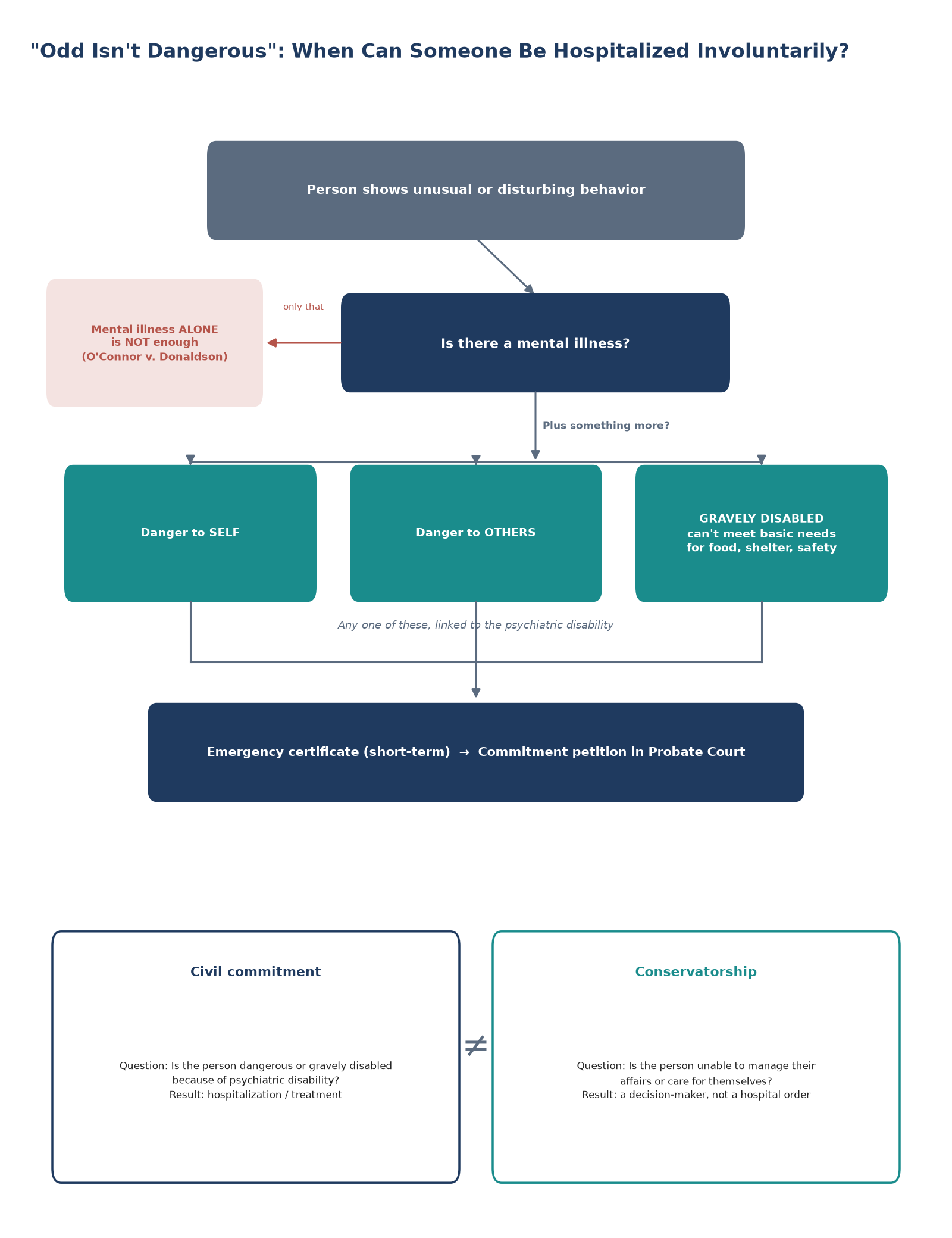
The Court went on: "A finding of 'mental illness' alone cannot justify a State's locking a person up against his will and keeping him indefinitely in simple custodial confinement." It also rejected public discomfort as a reason to confine someone: "Mere public intolerance or animosity cannot constitutionally justify the deprivation of a person's physical liberty." The Court asked whether a state could "incarcerate all who are physically unattractive or socially eccentric" to avoid public unease, and the obvious answer is no (id.).
So the man on the street can't be committed because he's embarrassing, eccentric, or even mentally ill. Something more is required.
The "something more": danger and grave disability
States, including Connecticut, define that "something more" in three ways:
- Danger to self. A real risk that the person will seriously harm themselves.
- Danger to others. A real risk that the person will seriously harm someone else.
- Grave disability. Because of a psychiatric disability, the person can't meet their own basic needs, such as food, clothing, shelter and safety, and is in danger of serious harm as a result. The Court itself pointed in this direction. It noted that a person can be "literally 'dangerous to himself'" if they are "helpless to avoid the hazards of freedom either through his own efforts or with the aid of willing family members or friends" (O'Connor, n. 9).
That's why the pants-around-the-ankles scenario usually doesn't support a commitment by itself. It could if it's the visible sign of something worse. Maybe it's January and he's going to freeze. Maybe he's walking into traffic. Maybe he hasn't eaten in days and can't take care of himself. Then the question becomes danger or grave disability, not oddness.
Connecticut's version
Connecticut's civil commitment law is in Chapter 319i, General Statutes § 17a-495 and following (cga.ct.gov, Chapter 319i (www.cga.ct.gov/current/pub/chap_319i.htm)):
- § 17a-495 contains the definitions, including "gravely disabled." The statute generally defines that as a person who, because of a psychiatric disability, is in danger of serious harm from being unable or failing to provide for basic needs such as essential food, clothing, shelter or safety, and who needs hospital treatment, but can't make an informed decision about it because of their condition. The exact text: a person who, "as a result of mental or emotional impairment, is in danger of serious harm as a result of an inability or failure to provide for his or her own basic human needs such as essential food, clothing, shelter or safety and that hospital treatment is necessary and available and that such person is mentally incapable of determining whether or not to accept such treatment because his judgment is impaired by his psychiatric disabilities" (§ 17a-495). "Dangerous to himself or herself or others" means "a substantial risk that physical harm will be inflicted by an individual upon his or her own person or upon another person."
- § 17a-497 and § 17a-498 cover commitment applications and hearings in Probate Court. The respondent has a right to notice, counsel and an examination by physicians. The court may order commitment only if it finds the person has a psychiatric disability and is "dangerous to himself or herself or others or gravely disabled," and the finding must be "by clear and convincing evidence," with the court "considering whether or not a less restrictive placement is available" (§ 17a-498(c)(3)). The court must have certificates from at least two impartial physicians, one a psychiatrist, who examined the person within ten days before the hearing (§ 17a-498(c)(1)).
- § 17a-502 covers emergency-certificate hospitalization by a physician, with limits on how long the person can be held and a right to a hearing.
- § 17a-503 lets a police officer take a person into custody and bring them to a hospital for an emergency examination when the officer has reasonable cause to believe the person has a psychiatric disability, is dangerous to themselves or others or is gravely disabled, and needs immediate care. Certain licensed clinicians can also issue emergency certificates under the same section.
On the standard of proof: in Addington v. Texas, 441 U.S. 418 (1979), the Supreme Court held that a "clear and convincing" standard of proof is required by the Fourteenth Amendment in a civil proceeding to commit an individual involuntarily for an indefinite period to a state mental hospital.
Commitment and conservatorship are different
Families and even professionals often mix these up.
- Civil commitment is about short-term or ongoing hospitalization for psychiatric treatment. It is governed by Chapter 319i and requires danger or grave disability.
- Conservatorship is about decision-making for someone who can't manage their personal needs or finances. It is governed by Chapter 802h and requires incapacity and a showing that less restrictive options won't work.
Someone can be conserved without ever being committed, and committed without being conserved. More importantly, being a conservator generally doesn't let you put the person in a psychiatric hospital against their will. Connecticut law limits a conservator of the person's authority over psychiatric hospitalization and treatment, and directs those decisions to the commitment and patient-rights statutes (Chapter 319i, including § 17a-543 on medication and treatment). Section 45a-656(d) says the conservator of the person "shall not have the power or authority to cause the respondent to be committed to any institution for the treatment of the mentally ill" except under those statutes, including §§ 17a-495 to 17a-528 and 17a-540 to 17a-550. If a conserved person is in crisis, the route is the same as for anyone else: an emergency evaluation, an emergency certificate, or a commitment application. It is not a conservator's signature.
Part 3: What to do after the appointment: the first six months
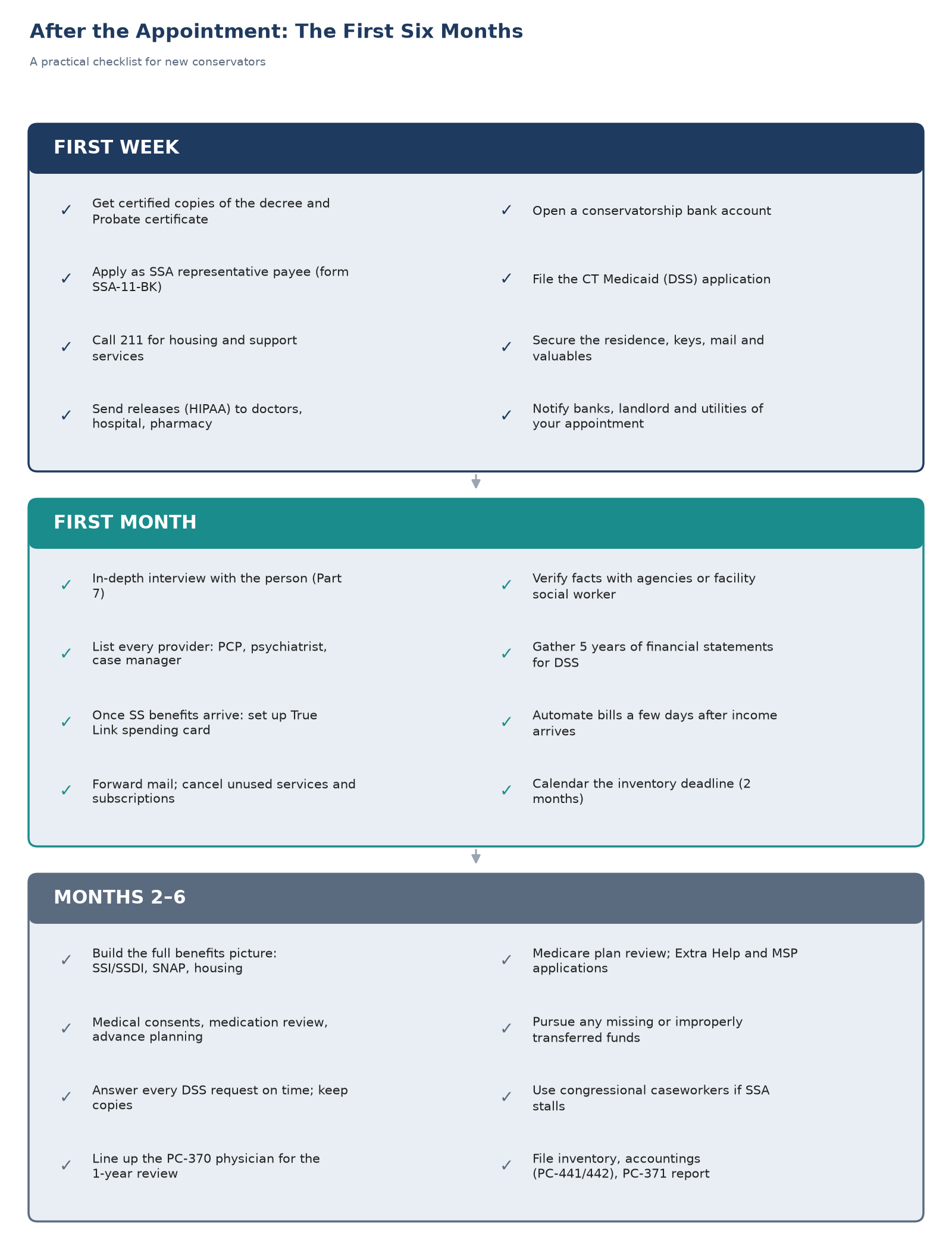
Once the decree is signed, the paperwork starts. Here's the checklist I teach.
The first week
- Get certified copies of the decree and Probate Court certificate. Banks, Social Security, DSS, Medicare and landlords will all ask for one. Order several.
- Open a conservatorship bank account. Title it the way Social Security and the bank expect, with the person's name and yours as conservator, so benefit deposits go in cleanly.
- Apply to Social Security as representative payee on form SSA-11-BK (see Part 6).
- File a Connecticut Medicaid application with DSS, whether or not you think you need one. It's far easier to start the process now than to scramble after a hospital stay.
- Call 211. 211 Connecticut is the state's access number for housing and support services. It's the fastest way to find shelter, housing programs, food and utility help near the person.
- Secure the home and property. Collect keys, check that the residence is locked and safe, gather mail, and put valuables, IDs, checkbooks and cards somewhere secure.
- Send releases to providers. Give doctors, the hospital, the pharmacy and any facility a copy of your certificate with a signed release (see Appendix, Template 1) so they'll talk to you.
- Notify banks, the landlord and utilities of your appointment, and ask that statements and notices come to you.
The first month
- Interview the person in depth (Part 7 covers how). Ask where they live: rented apartment, shelter, hotel, condo or house. Ask about every bill: electric, gas, cable, phone, storage unit. Ask about their providers, doctors and family contacts, and whether there's a spouse or children.
- Don't rely only on the person for this information. It may be out of date or incomplete. Confirm it with the community social services agency or, if the person is in a nursing home, the facility social worker.
- Get the names of every provider: primary-care doctor (you'll need them for the periodic medical review), psychiatrist (for medications), and case managers.
- Start gathering five years of financial records. DSS will want them for the Medicaid application (Part 5). Request statements from every bank, brokerage, insurer and retirement plan you find.
- Set up daily spending money. Spending money can now be handled through prepaid card services such as True Link (truelink.com). Set up the True Link account after you start receiving the person's Social Security benefits as representative payee, then load a set amount each week or month. The card lets the person keep some independence and dignity while you control where and how much they can spend, and every purchase shows up in a record you can use for your accountings.
- Set up automatic payments for every bill you can. Schedule them a few days after benefits or income arrive, for example on the 3rd, so they never bounce.
- Forward mail and cut waste. File a change of address, and cancel unused subscriptions, duplicate phone lines and services the person no longer uses.
- Calendar your deadlines. The inventory is due within two months of appointment (§ 45a-655(a)). Put the one-year review, annual reports and benefit renewals on the calendar now.
Months two through six
- Build the benefits picture: Social Security or SSI, Medicare, Medicaid, SNAP food benefits (with careful grocery planning, they can stretch a long way), housing supports (Section 8, Department of Developmental Services vouchers, group homes), in-home services, and Connecticut's Money Follows the Person program for people moving from institutions back to the community. If the person is a veteran, add VA disability and TRICARE.
- Review Medicare coverage (Part 4). Check the person's plan, and apply for Extra Help and a Medicare Savings Program if they qualify.
- Take care of medical decision-making: have releases in place so providers will talk to you, track procedures that need consent, review medications with the prescriber, and talk about hospice when it becomes relevant.
- Chase missing money. If the records show gifts, transfers or withdrawals you can't explain, start recovering them now (Part 5).
- Answer every DSS request on time and keep copies of everything you send.
- When Social Security stalls, call your U.S. Senator's or Representative's constituent services office. Caseworkers there help constituents of every political stripe with federal agencies, and they're often the fastest way to get a stuck file moving.
- Line up the physician for the one-year review (PC-370), so the exam can happen within the required window.
- Report to the court. File the inventory, accountings (PC-441 or PC-442) and the conservator's report (PC-371) the court requires, and finish the Medicaid process before you report.
Part 4: Medicare
Medicare is the federal health insurance program for people 65 and older and for certain younger people with disabilities, ALS or permanent kidney failure (ssa.gov, "Plan for Medicare" (www.ssa.gov/benefits/medicare)). For a conservator, it's usually the first and most important coverage to get right. The figures below are 2025 amounts from the Centers for Medicare & Medicaid Services (CMS 2025 fact sheet (www.cms.gov/newsroom/fact-sheets/2025-medicare-parts-b-premiums-and-deductibles)).
A short history
President Lyndon B. Johnson signed the Social Security Amendments of 1965 into law on July 30, 1965, creating both Medicare and Medicaid. The original Medicare program had two parts: Part A (hospital insurance) and Part B (medical insurance), now called "Original Medicare." In 1972 Congress expanded Medicare to cover people with long-term disabilities and people with end-stage renal disease (ESRD) who need dialysis or a kidney transplant (CMS, "History" (www.cms.gov/about-cms/who-we-are/history)). The Balanced Budget Act of 1997 created Medicare+Choice, which let private plans deliver Medicare benefits. The Medicare Prescription Drug, Improvement, and Modernization Act of 2003 renamed those private plans Medicare Advantage (Part C) and created the optional prescription drug benefit, Part D, which took effect in 2006.
Who qualifies, and how
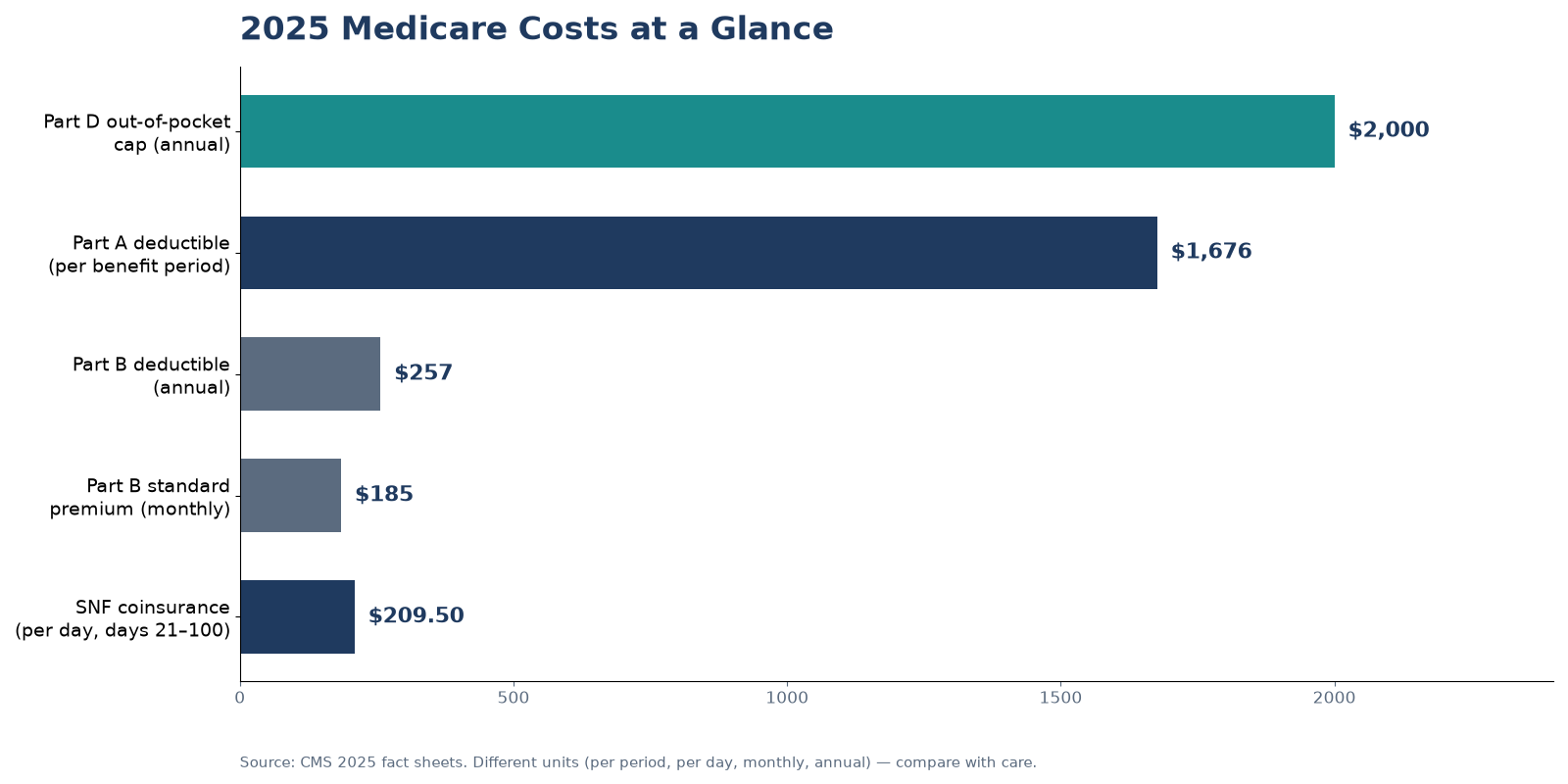
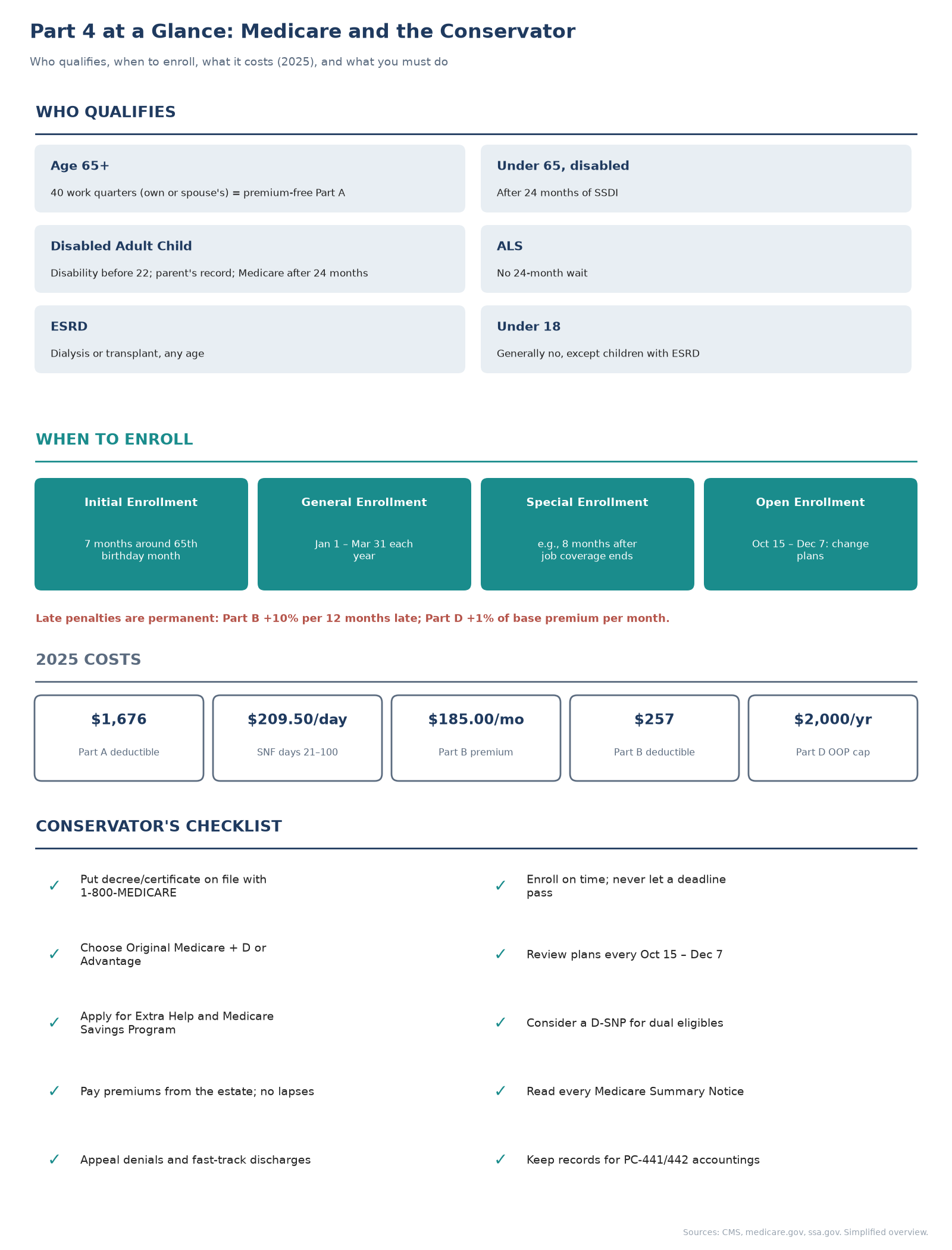
- Age 65 and older. Most people qualify at 65 based on their own work history or a spouse's. Forty quarters (about 10 years) of work paying Medicare taxes earns premium-free Part A; people with fewer quarters can buy Part A (in 2025, $285 a month with 30–39 quarters, or $518 a month with fewer than 30).
- Under 65 with a disability. A person who has received Social Security disability benefits (SSDI) for 24 months becomes eligible for Medicare automatically (medicare.gov). Many conserved people qualify this way.
- ALS (Lou Gehrig's disease). There is no 24-month wait; Medicare starts as soon as disability benefits begin.
- ESRD. People with permanent kidney failure who need regular dialysis or have had a transplant can qualify at any age, based on their own or a parent's or spouse's work record.
- Under 18? Generally no. Children usually get health coverage through Medicaid (HUSKY) or a parent's plan. The main exception is a child with ESRD: a child who needs regular dialysis or has had a kidney transplant can get Medicare if a parent (or the parent's spouse) has earned enough Social Security work credits or receives Social Security benefits (medicare.gov, "Children & ESRD" (www.medicare.gov/basics/children-and-end-stage-renal-disease)).
- Disabled Adult Child (DAC) benefits. An adult whose disability began before age 22 can collect a "child's" Social Security benefit on a parent's record once the parent retires, becomes disabled or dies. The person must be unmarried and 18 or older, and doesn't need a work history of their own. After 24 months of DAC benefits, the person gets Medicare (ssa.gov). For a conserved person on SSI alone, checking for DAC eligibility can mean a higher benefit and Medicare. It's worth asking about every parent's work history.
When to enroll, and the penalties for waiting
- Initial Enrollment Period (IEP). Seven months: the three months before the month a person turns 65, that month, and the three months after. People who qualify through disability are enrolled automatically after 24 months of benefits.
- General Enrollment Period. January 1 to March 31 each year, for people who missed their IEP.
- Special Enrollment Periods. For example, within eight months after the person or a spouse stops working or loses job-based coverage.
- Late penalties. The Part B premium goes up 10% for each full 12-month period the person could have had Part B but didn't, usually for as long as they have Part B. The Part D penalty adds 1% of the national base premium for each month without creditable drug coverage. The Part A penalty (for people who buy Part A) is 10%, for twice the number of years they delayed. Penalties are permanent, so missing a deadline for a conserved person is an expensive mistake.
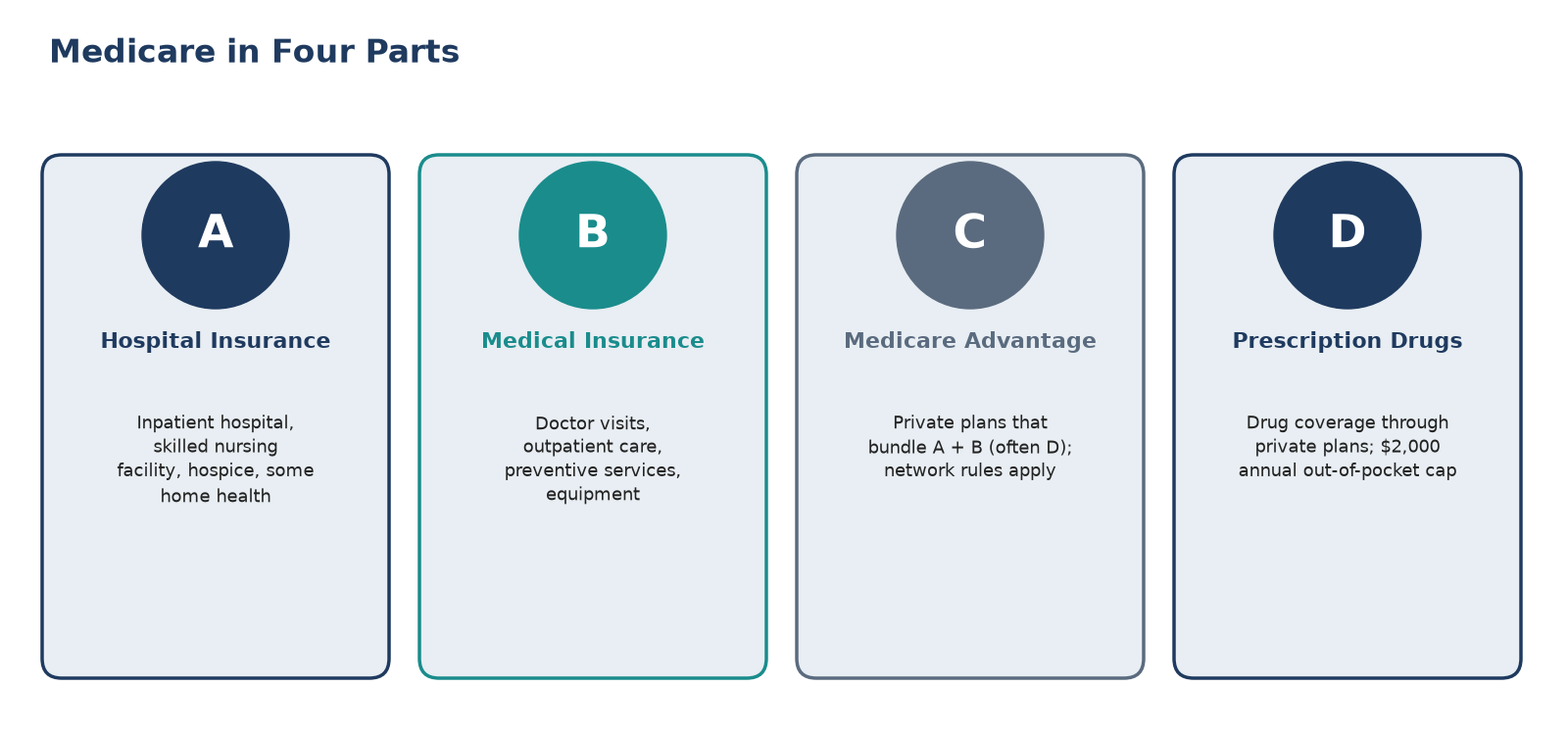
What each part covers (2025 costs)
- Part A (hospital insurance) covers inpatient hospital stays, skilled nursing facility care after a qualifying hospital stay, hospice, inpatient rehabilitation and some home health care. About 99% of people pay no premium. In 2025 the inpatient deductible is $1,676 per benefit period, with coinsurance of $419 a day for days 61–90. Skilled nursing care costs nothing for days 1–20 and $209.50 a day for days 21–100. Part A doesn't pay for long-term custodial nursing home care. That's Medicaid's job (Part 5).
- Part B (medical insurance) covers doctor visits, outpatient hospital care, mental health services, preventive care, lab work and durable medical equipment. The standard 2025 premium is $185.00 a month (more at higher incomes), with a $257 annual deductible and usually 20% coinsurance after that.
- Part C (Medicare Advantage) plans are private plans that deliver Part A and Part B benefits, and usually Part D (see below).
- Part D (prescription drugs) is offered through private plans, and costs vary by plan and pharmacy. Starting in 2025, out-of-pocket costs for covered drugs are capped at $2,000 a year; once a person reaches the cap, they pay nothing more for covered drugs that year. The Inflation Reduction Act also eliminated the old "coverage gap" (CMS (www.cms.gov/files/document/lower-out-pocket-drug-costs-2024-and-2025-article.pdf)).
- Medigap (Medicare Supplement Insurance) is private coverage that fills in Original Medicare's deductibles and coinsurance. It requires Part B and doesn't work with Medicare Advantage.
Medicare Advantage plans
Medicare Advantage (Part C) plans are run by private insurers approved by Medicare. They must cover everything Original Medicare covers, and most include drug coverage. What changes is how the person gets care:
- Networks. Most plans are HMOs or PPOs. An HMO usually requires in-network doctors and hospitals (except in emergencies) and referrals to specialists. A PPO lets the person go out of network for a higher cost.
- Prior authorization. Plans often require approval before certain services, admissions or drugs. That can delay care, and a conservator needs to know how to request it and how to appeal a denial.
- Extras. Many plans add dental, vision, hearing, transportation, gym or over-the-counter allowances, and each plan has a yearly out-of-pocket maximum.
- How to choose. Start with the person's doctors, psychiatrist, hospitals and pharmacy, and check that every one is in network. Then check that the plan covers each medication (its formulary), compare total yearly costs, not just the premium, and look at the plan's star rating. Use the Medicare Plan Finder at medicare.gov.
- D-SNPs for dual eligibles. People with both Medicare and Medicaid can join a Dual Eligible Special Needs Plan (D-SNP). These plans must include drug coverage, offer care coordination, and help coordinate Medicare and Medicaid benefits (medicare.gov, "Special Needs Plans" (www.medicare.gov/health-drug-plans/health-plans/your-coverage-options/SNP)). There are also Institutional SNPs for people living in nursing homes.
When a conservator runs into Medicare, and what to do
You'll deal with Medicare at appointment, at hospital admission and discharge, at nursing home placement, when the person turns 65 or reaches 24 months of disability benefits, and every fall during Open Enrollment. Your responsibilities include:
- Document your authority. Call 1-800-MEDICARE and send a copy of your Probate Court decree and certificate so Medicare records you as the person's legal representative. Without it, Medicare won't discuss the account with you. If the person can sign, Form CMS-10106 (Authorization to Disclose Personal Health Information) also works. Ask 1-800-MEDICARE where to send the documents.
- Make enrollment and disenrollment decisions. Enroll the person when they're first eligible and don't let a deadline pass. Decide between Original Medicare plus Part D (and possibly Medigap) or a Medicare Advantage plan, and change plans when the person's needs change.
- Review plans every Open Enrollment, October 15 to December 7. Formularies, networks and costs change every year. Check that the person's doctors and drugs are still covered.
- Apply for help with costs. Apply for Extra Help (the Part D low-income subsidy) through Social Security, and for a Medicare Savings Program through DSS, which can pay the Part B premium and sometimes deductibles and coinsurance. Income limits change every year, so check the current figures with DSS.
- Pay premiums from the estate. Keep premiums current, whether they're deducted from Social Security or paid directly, and never let coverage lapse for nonpayment.
- Read every Medicare Summary Notice and plan statement. Look for services the person didn't get, which can be a sign of fraud, and for denials.
- Appeal. File appeals of denied claims or terminated services on time. Hospital and skilled nursing discharges have fast-track appeal rights.
- Coordinate with Medicaid. For dual eligibles, Medicare pays first and Medicaid fills the gaps. Make sure providers bill both, and consider a D-SNP.
- Keep records. Keep copies of enrollment notices, premium payments and correspondence. You'll need them for your court accountings (PC-441 or PC-442) and for Medicaid renewals.
Part 5: Medicaid (HUSKY C) and the application
Medicaid is the joint federal-state program that pays for long-term care. In Connecticut it's branded HUSKY Health. HUSKY C is the coverage group for people who are 65 or older, blind, or disabled, and it's the one that pays for nursing home care and many home- and community-based services. Unlike HUSKY's income-based groups, HUSKY C has an asset limit as well as income rules. Certain assets are excluded, such as a primary home in many situations, one vehicle, and burial arrangements. The HUSKY C asset limit is $1,600 for an individual. Income rules vary by coverage group and living arrangement, so check the current figures with DSS.
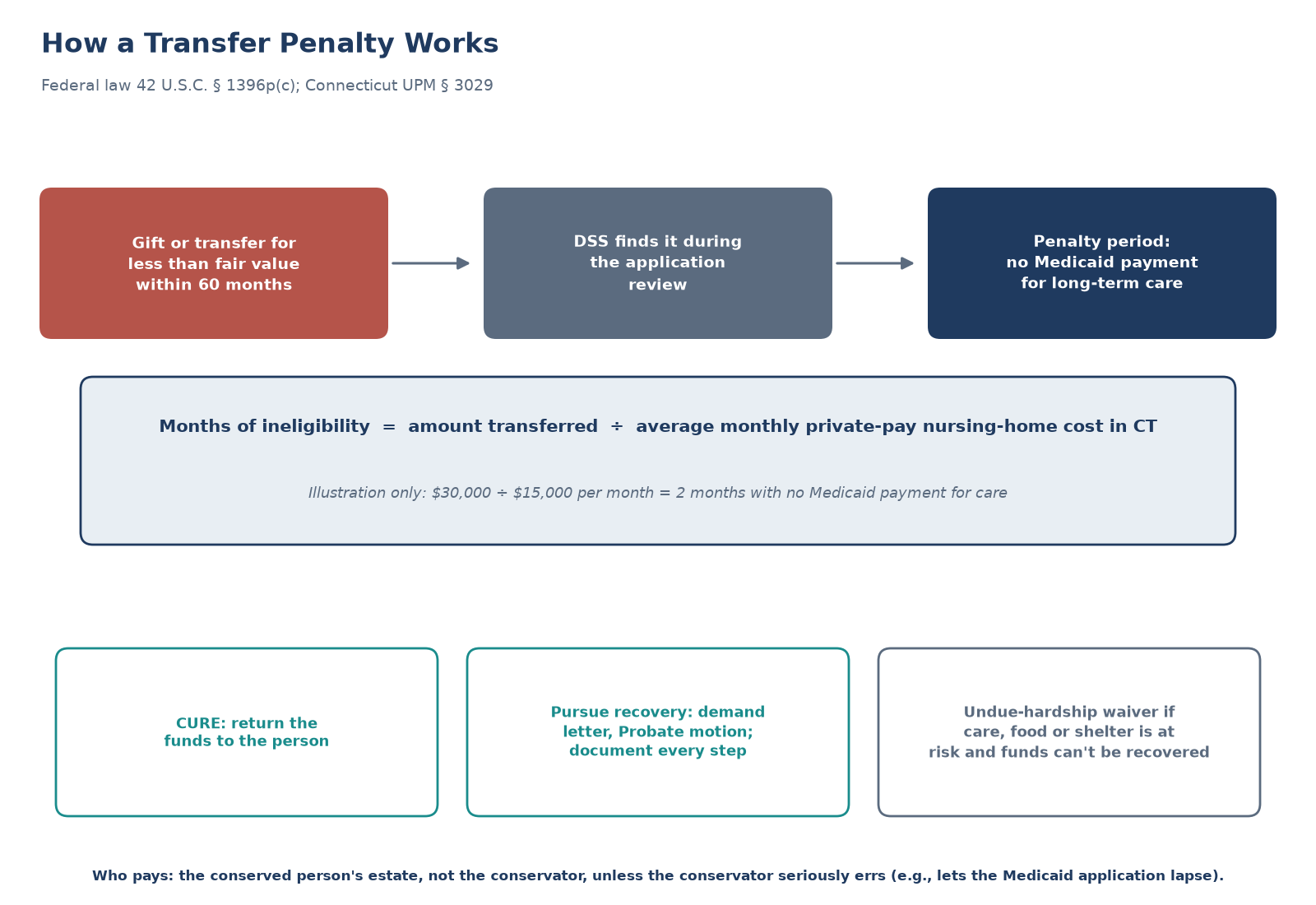
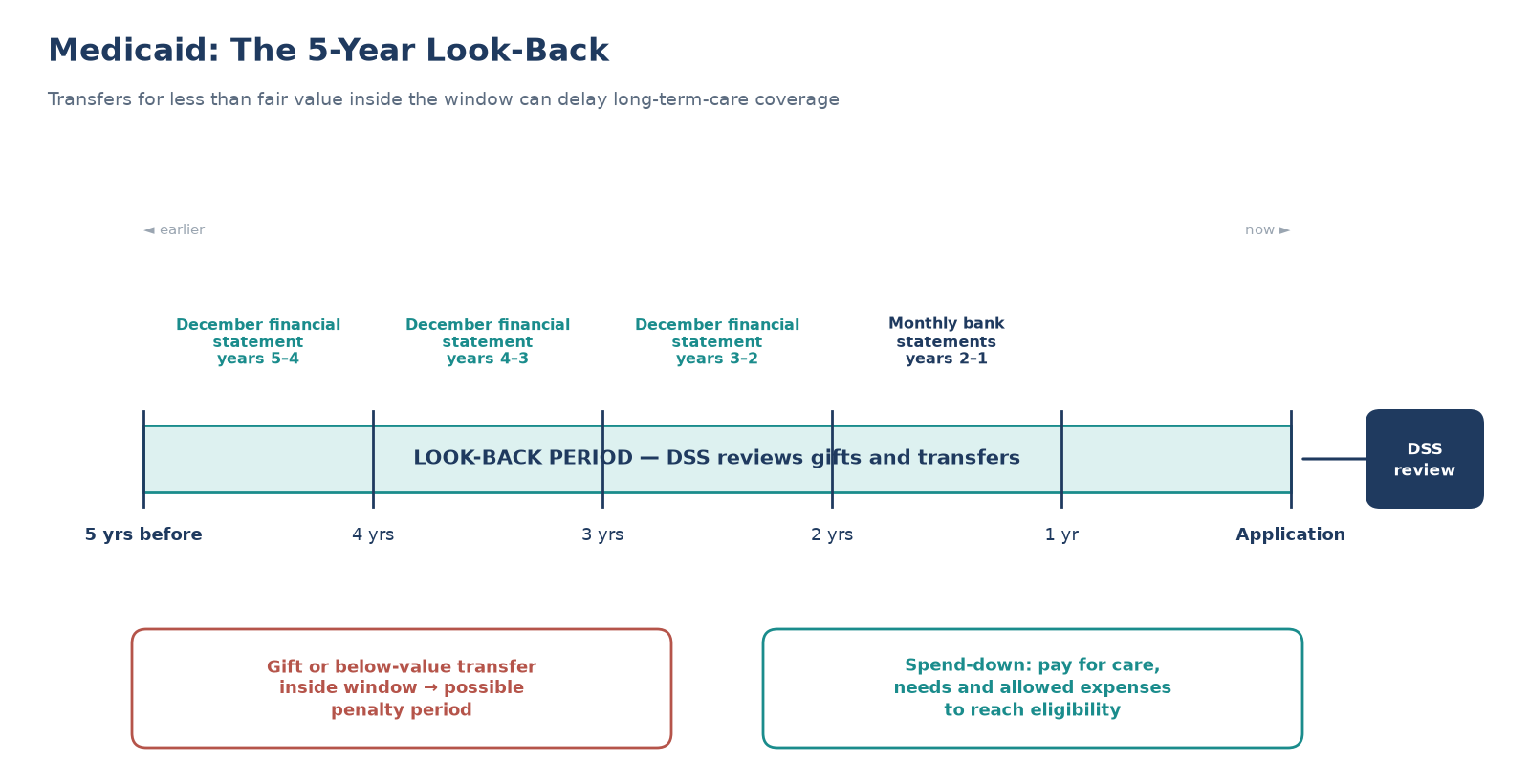
The five-year look-back. For long-term care, DSS reviews every transfer of assets made in the 60 months before the application (42 U.S.C. § 1396p(c)(1)(B); Connecticut Uniform Policy Manual (UPM) § 3029.05). It isn't just checking accounts. Expect DSS to ask about, and run its own search for:
- checking and savings accounts, certificates of deposit and money market accounts;
- brokerage accounts, stocks, bonds and mutual funds;
- retirement accounts such as IRAs and 401(k)s;
- annuities, which the federal law addresses specifically (42 U.S.C. § 1396p(c)(1)(F)–(G));
- the cash value of life insurance policies;
- real estate and deeds, including any property added to or removed from the person's name;
- vehicles, boats and other titled property;
- trusts the person created or funded;
- safe deposit boxes;
- joint accounts, where taking money out or removing the person's name can count as a transfer (42 U.S.C. § 1396p(c)(3));
- payment apps such as PayPal, Venmo and Cash App;
- cryptocurrency and other digital assets.
Gifts to family count, even small ones. Many families assume a gift is fine if it stayed under the IRS annual gift-tax exclusion. It isn't. The IRS gift rules are tax rules. They don't apply to Medicaid, which treats any gift or transfer for less than fair market value inside the look-back as a transfer. Birthday checks, help with a grandchild's tuition, or "loans" to a relative with no written terms can all count. The usual cure is to return the funds. Federal law and the UPM don't penalize a transfer when all of the assets have been returned to the person (42 U.S.C. § 1396p(c)(2)(C)). A person can also avoid a penalty by showing that the transfer was for fair value, or made solely for a purpose other than qualifying for Medicaid. Connecticut requires clear and convincing evidence of that purpose (UPM § 3029.10).
What happens when DSS finds a transfer. Say the person gave money to a relative who won't give it back. DSS imposes a transfer penalty: a period of ineligibility during which Medicaid won't pay for nursing-home or other long-term care services. The length of the penalty is the total uncompensated value of everything transferred, divided by the average monthly private-pay cost of nursing-home care in Connecticut (42 U.S.C. § 1396p(c)(1)(E); UPM § 3029.05(F)). DSS publishes that average and updates it periodically. For an applicant, the penalty starts on the date the person would otherwise be eligible for Medicaid coverage of that care. During the penalty, the cost of care isn't covered by Medicaid and falls on the person and the estate. In practice, that usually means an unpaid nursing-home bill.
Who pays during a penalty. During a transfer penalty, the conserved person, through their estate, is ordinarily the one liable for the cost of care. The conservator isn't personally liable for it. The exception is a serious mistake in the conservator's own job, such as letting the Medicaid application lapse or never filing it. Nursing homes have sued conservators personally for that. In Bloomfield Health Care Center of Connecticut, LLC v. Doyon, 185 Conn. App. 340 (2018), a conservator of the estate waited nine months to file a Medicaid application, then let it be denied for failing to send DSS the information it requested. The Appellate Court held that the conservator owed the nursing home a duty of reasonable care to apply for Medicaid on time, and that the nursing home could sue him for negligence even though no probate bond had been issued. The court relied on Jewish Home for the Elderly of Fairfield County, Inc. v. Cantore, 257 Conn. 531 (2001), which allowed a nursing home to recover on a conservator's probate bond for the same kind of failure. The lesson is simple: file on time, answer every DSS request, and get Probate Court approval for major decisions.
Your job is also to protect and recover the person's assets. Pursue recovery of the transferred funds: send a written demand letter, ask the Probate Court to order the money returned, report theft to the police, and document every step for both DSS and the court. Returned funds can end or shorten the penalty, and your record of recovery efforts supports a hardship claim.
The undue-hardship exception. Federal law requires every state to have a process for waiving a transfer penalty that would cause undue hardship. Federal law defines that as denying eligibility that would deprive the person of medical care, endangering their health or life, or of food, clothing, shelter or other necessities of life (Deficit Reduction Act of 2005, § 6011(d); 42 U.S.C. § 1396p(c)(2)(D)). Connecticut's policy also looks at whether the transferred assets can't be recovered despite good-faith efforts, and whether the person faces losing their nursing-home bed or services, among other factors (UPM § 3029.25). The nursing home can file the hardship claim with the person's or the conservator's consent, and an adverse decision can be appealed through a DSS fair hearing. Your record of recovery efforts is often the best evidence you have.
Spend-down. A person who is over the asset limit can "spend down" on legitimate expenses, such as care, needed goods, prepaid funeral arrangements or paying debts, until they're under the limit. When a conservator sells property as part of a spend-down, they need Probate Court approval, which also protects the conservator.
Trusts. Federal law allows certain trusts to hold assets without counting them against Medicaid eligibility. One is a first-party special needs trust for a disabled person under 65. Another is a pooled trust run by a nonprofit. Both generally have to pay back the state from what's left when the person dies. Setting one up is a job for an elder-law attorney.
Applying through DSS. Apply through the Connecticut Department of Social Services online, by mail, or in person (portal.ct.gov/dss). A few lessons learned the hard way:
- Know who's responsible. If the person is in a nursing home, the facility (often through outside companies or attorneys) usually prepares the application, and you assist and sign the authorizations. If the person lives in the community, you're responsible.
- Find every asset. Counting back from the application date, expect DSS to ask for the December financial statements for years 5–4, 4–3 and 3–2, and monthly bank statements for years 2–1. Start requesting them on day one. DSS also runs its own asset search and will ask about accounts it finds.
- Watch the deadlines. Requests for more information come with short turnaround deadlines. Answer each one completely and on time, and keep copies of everything you send.
- Expect a trickle. Documents come in a few at a time. Be persistent with banks. You don't have to be patient with institutions that sit on your requests.
- Protect the money. If you find that someone has been taking the person's funds, report it to the police and the court, and document it for DSS.
- When it's approved, report to the court.
Part 6: Social Security representative payee, briefly
A court-appointed conservator does not automatically get control of Social Security or SSI benefits. Social Security appoints its own representative payee, and you have to apply directly with Social Security (ssa.gov/payee).
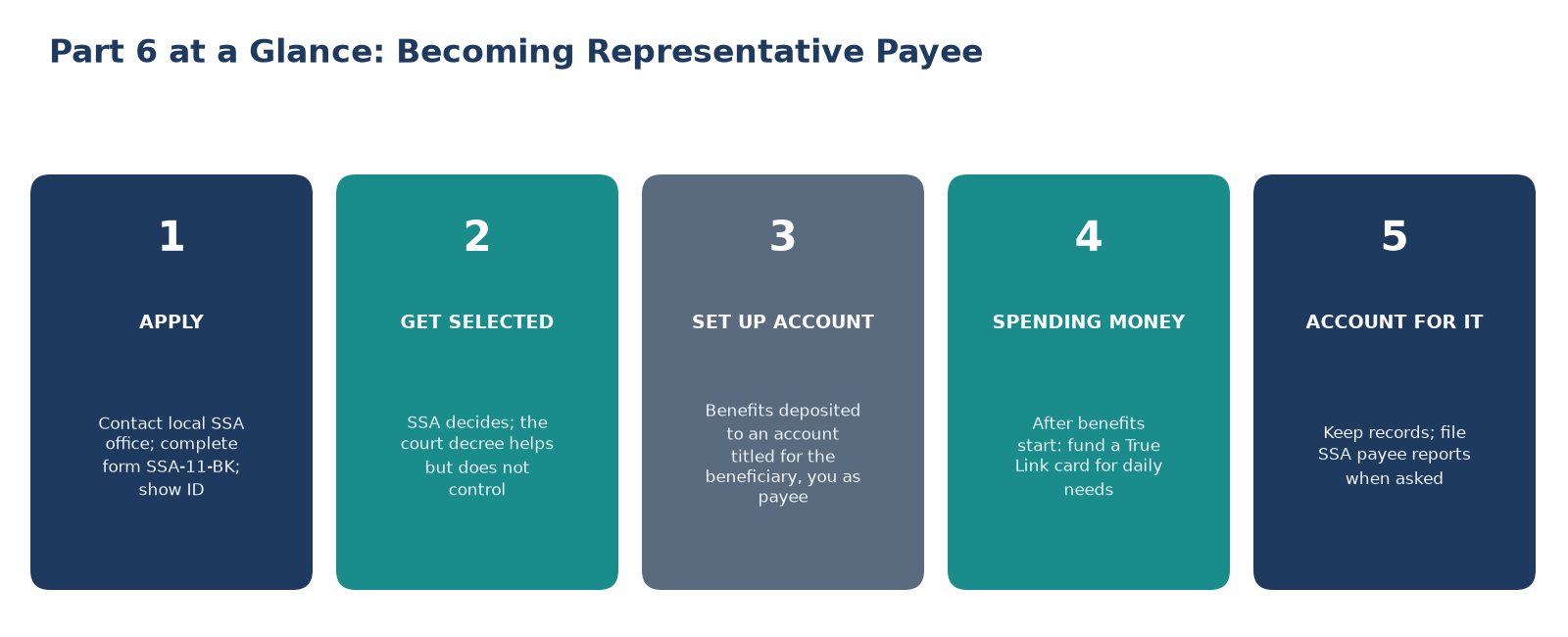
- Apply on form SSA-11-BK (Request to Be Selected as Payee). Contact the local Social Security office. The application is usually taken face to face, and you'll need to show identification and give your Social Security number (or, for an organization, its employer identification number). Bring the Probate Court decree and certificate. They show why the person needs a payee, but Social Security makes its own decision.
- Use the money for the person. Benefits go first to current needs: housing, food, utilities, medical costs and personal items. Save what's left for the person.
- Bank it correctly. Deposit benefits into an account titled the way Social Security requires, showing the beneficiary as owner and you as payee. Benefits must be paid electronically.
- Spending money. After the benefits start arriving, set up a True Link card or similar prepaid card for the person's daily spending money (see Part 3).
- Keep records and report. Keep receipts and records of how every dollar was spent or saved. Social Security mails most payees an annual Representative Payee Report (form SSA-623, or SSA-6230 or SSA-6234 depending on the case), which individual payees can also complete online through my Social Security. Parents and spouses living with the beneficiary are exempt from the annual report, but they still have to keep records (ssa.gov/payee).
- Expect to be reviewed. Social Security monitors payees beyond the annual report. Under the Strengthening Protections for Social Security Beneficiaries Act of 2018, each state's protection and advocacy organization conducts payee reviews for SSA. A review includes an interview with the payee, an examination of financial records, a home visit with the beneficiary, and interviews with guardians or conservators. Payees serving 15 or more beneficiaries, organizational payees and fee-for-service payees get a periodic onsite review every three to four years. Other individual payees can be selected at any time through SSA's predictive-model and targeted reviews. Keep your records ready for a review at any time; a review that finds problems can lead to corrective action or removal as payee.
Part 7: The Heart of the Interview: Interviewing Dual-Diagnosed, At-Risk Clients
Everything above depends on information, and most of it has to come from the person you're serving. I've spent decades interviewing people who didn't want to talk. As an elementary teacher trained in constructivist methods, I interviewed each child individually to find out where they were and what they wanted to learn. In child protection work I interviewed children and parents after traumatic events, often children in foster care who just wanted to go home. As an attorney, I represented parents and children in child-protection cases, including cases involving sexual-abuse allegations. The same skills apply to conservators, case managers and housing providers who work with clients who have co-occurring mental illness and substance use disorders, often called dual-diagnosed clients, and who are frequently involved with the justice system. I developed this method for a county social services training.
Communication is messy
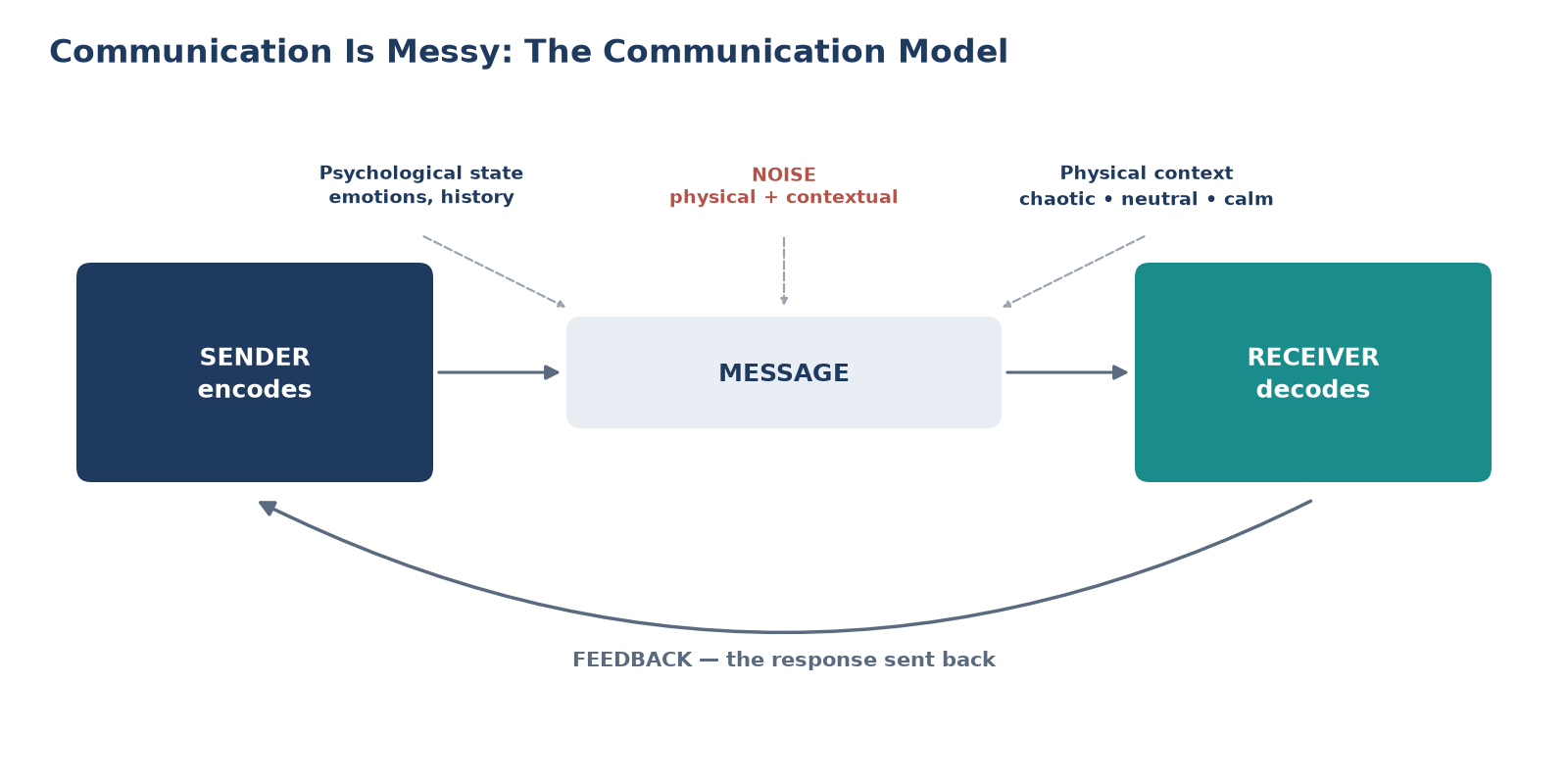
Every message passes through the sender's psychological, emotional and physical state, the setting, and "noise," meaning everything else going on, before the receiver decodes it through their own state. Change one element and the message changes. A sad person saying "Fine, thank you" isn't telling you they're fine. In the often-cited conversational model, words carry only about 7% of the meaning, and tone and body language carry the rest. That figure is a popularized reading of Albert Mehrabian's research on feelings and attitudes, so treat it as a reminder, not a rule. In an interview, words matter more, because your questions are how you get the information. Keep your tone neutral to slightly friendly, and keep your body language neutral. Avoid both aggressive and defensive postures.
Your own biases: the curse of knowledge and the curse of experience
Your education gives you filters, and filters lead to assumptions. Your experience ("I've worked with this population for 20 years") tempts you to think you already know the story. Both are valuable after the interview, when you build the plan. During the interview, set them aside and listen. The antidote I use is mindfulness, meaning staying present in the moment. One plus one equals two, but one cloud plus one cloud is still one cloud. All facts are conditional, and what was true for the last client may not be true for this one.
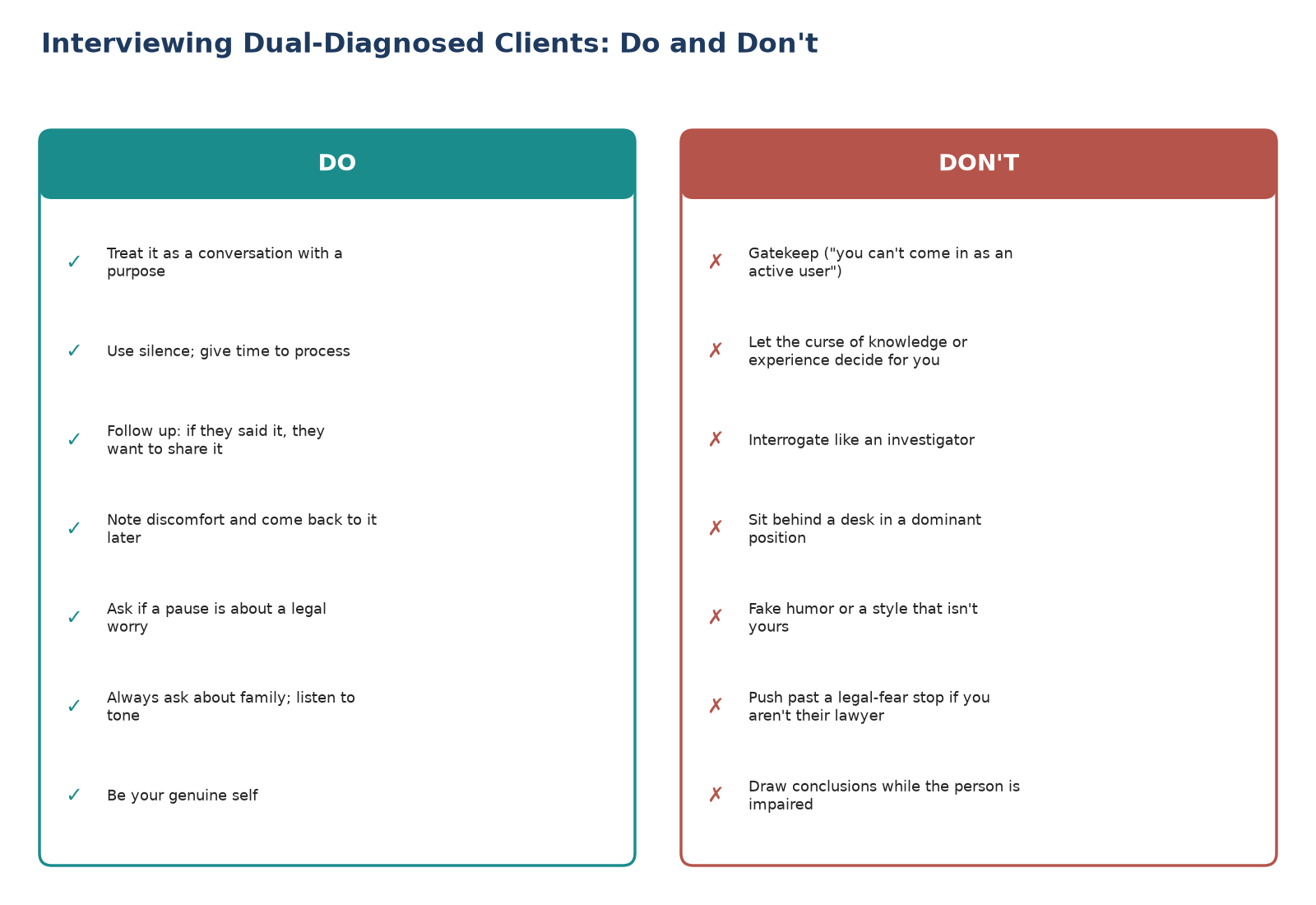
Don't be a gatekeeper
Too many interviewers look for reasons to say no. Interview for how to make it work. With co-occurring disorders, relapse is part of recovery, not proof of failure. What you need to learn is what triggers this person, what should be in place to avoid those triggers, and what they'll need to get back on track when a relapse happens. Only the person has that information. The interviewer is about as replaceable as the clock on the wall or the chair in the corner. The interviewee is the one person in the room who can't be replaced.
Their bias: the brain loves itself
Egocentric bias means people want to look good, so they resist sharing the negative or traumatic history you most need to hear. Your personality matters less than you'd think. You don't have to be gregarious. Be genuine and work with the strengths you have. Humor can backfire. I once had an interview ended because the person didn't appreciate a joke. Seating matters too. A desk between you sets up a dominant-subordinate dynamic, and a conversational setup gets more information.
Safety and security
My safety habits come from child protection and from my time as an Army military police soldier:
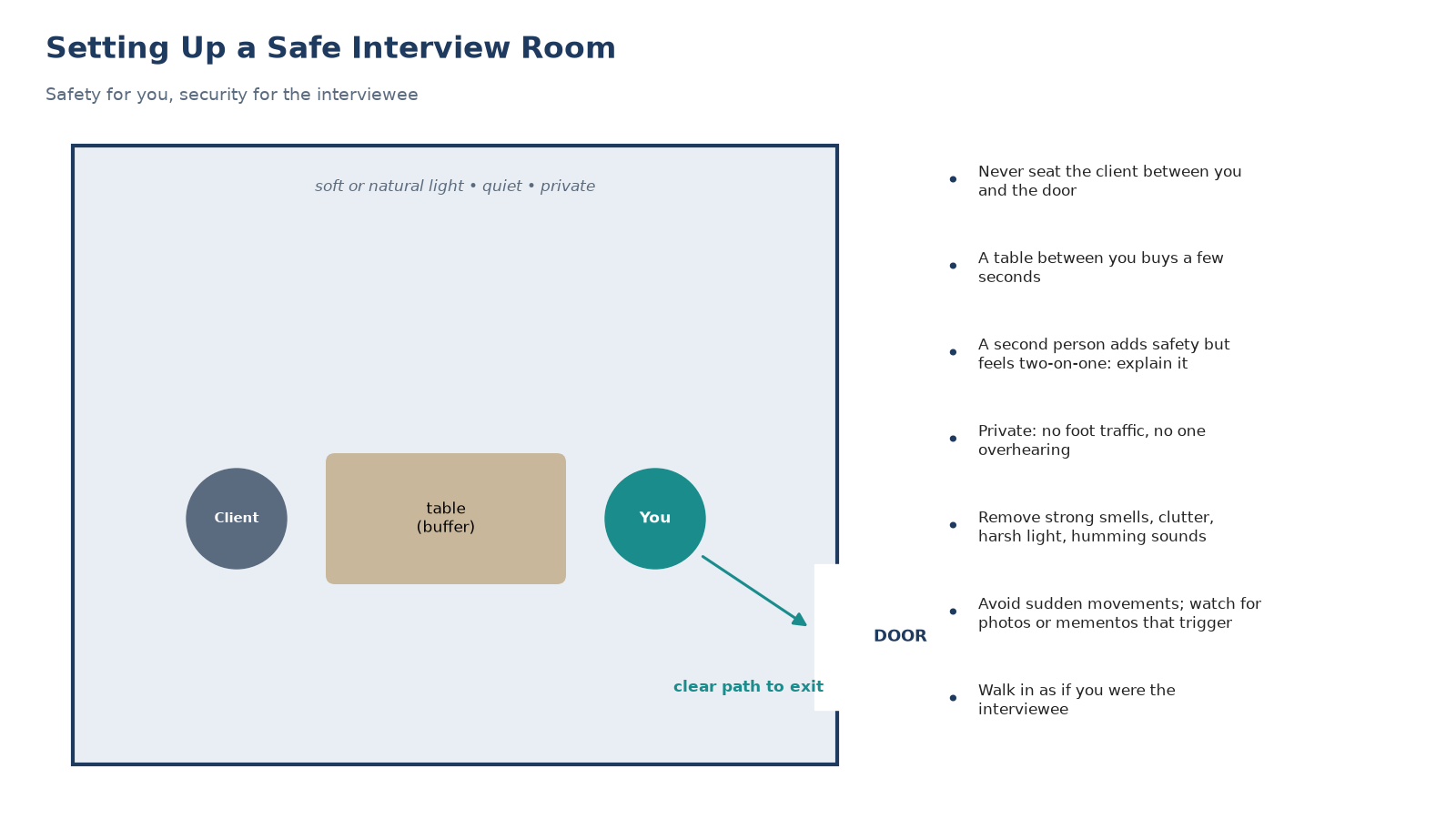
- Keep an unblocked exit, and never seat the interviewee between you and the door.
- Put a buffer, such as a table or coffee table, between you. It buys a few seconds if things escalate.
- A second person may be necessary, but it creates a two-on-one dynamic, so explain why they're there.
- Recording. I record for accuracy and tell the person why, and I still take handwritten notes. If they object, I turn it off and gently ask why, which sometimes opens up something important. Recording laws vary by state and by whether the conversation is in person or by phone, so check with an attorney before you record.
The interviewee needs security too: a private, calm space where people aren't walking through and can't overhear, and an interviewer whose tone doesn't feel like an attack. You control the room, so walk into it as if you were the interviewee. Look for strong smells like perfume, clutter, harsh lighting (soft or natural light is better), sudden movements (which can be especially triggering for justice-involved clients), windows with distracting views, and humming or sharp sounds. Family photos and mementos can trigger people in ways you won't see coming.
Trauma, cognition and co-occurring conditions
Many clients carry complex trauma and cognitive limitations. They may have a smaller vocabulary, need more time to process a question, or struggle to explain. They may show affective behaviors or have trouble with authority, personal space or gender dynamics. Meet all of that calmly and professionally. Signs of intoxication, withdrawal and psychiatric symptoms can look alike. If the person seems impaired, note what you see, keep the conversation short and safe, and come back later instead of drawing conclusions. Guidance on co-occurring disorders recommends this kind of integrated, non-judgmental approach. Trauma-informed practice emphasizes safety, choice and collaboration. My four-step method fits well with motivational interviewing's focus on open questions and reflective listening.
A conversation, not an interrogation
In a good interview the interviewer talks only 10 to 15% of the time. Keep the approach positive. The power imbalance already exists, because you have what they need. Don't open by reading the rules, which comes across as authoritarian. If they ask about the rules, ask why that matters to them. The answer is often the key to making it work.
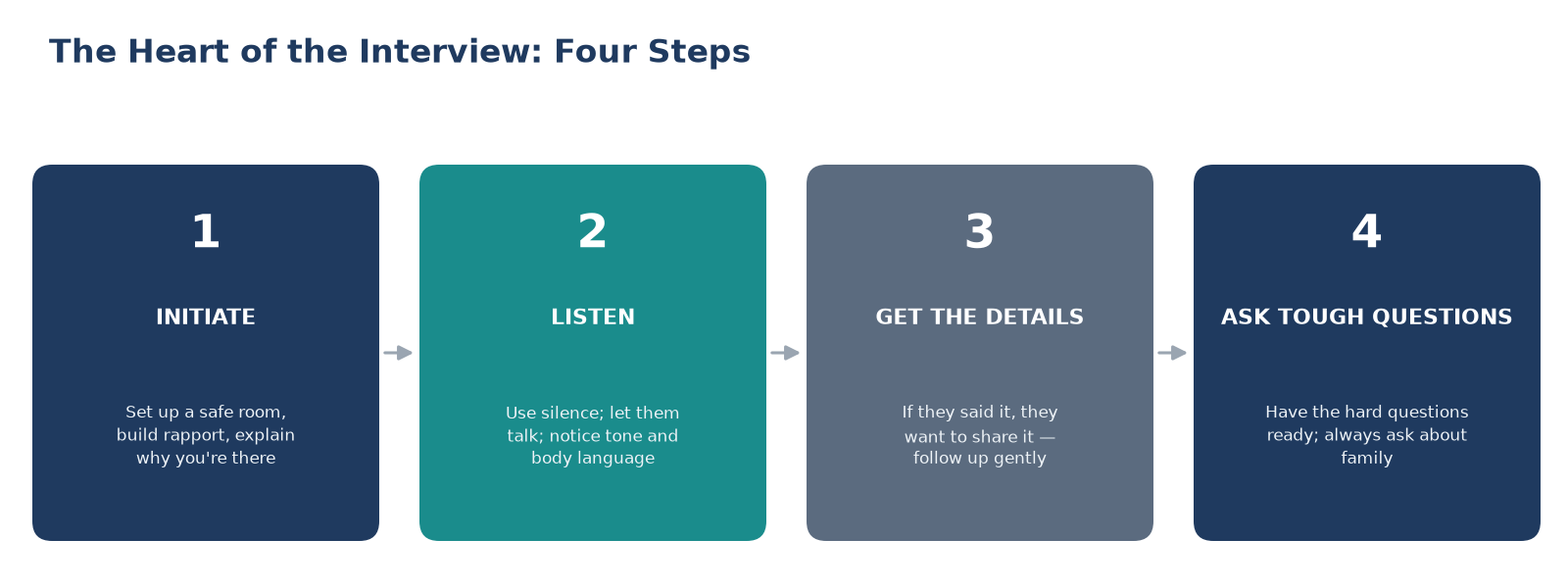
The four steps
- Initiate. Start as two adults talking. Leave the pen and paper away at first. Share a few genuine personal stories, never borrowed ones. Talk about a hobby or an interest, and let them see you as a person.
- Listen. They're the expert in their own life, and you're there to learn. Silence is a motivator, so let them fill it. Take notes, because it tells them their words matter. If they ask to see your notes, don't refuse flatly. Explain what's professional work product and show them the pages that are their own words. Use active listening: "Just so I understand, you're saying…" Many clients have told their story to caseworkers, attorneys, clinicians and psychiatrists for years and have never felt heard. One good summary can change the whole interview.
- Get details. Always follow up. "That wasn't a good time for me" should lead to more questions. What about it? What would have helped? What else was happening? If they said it out loud, they want to talk about it, so give them time and space. If they stop suddenly, ask whether they're worried about a legal issue. If they are and you're not their attorney, don't push. Otherwise, make a note and come back to it.
- Ask the tough questions. You've read the hospital and legal intakes, so you know what you need. This isn't an investigation, though. You catch more flies with honey. Always ask about family, and listen to the tone and watch the body language as much as the words, because how someone talks about family tells you how they handle relationships. Be ready for that question to set off a strong reaction.
When to bring in crisis services
If during the interview the person talks about suicide or harming someone, seems acutely intoxicated or in medical danger from withdrawal, or can't meet their basic needs, stop the interview and get help. In the U.S. you can call or text 988, the Suicide & Crisis Lifeline, or call 911 if someone is in immediate danger. For housing and support services, 211 Connecticut is the access number to call. That's the line Part 2 described, where an interview becomes a question of danger or grave disability.
This article is general information and not legal advice. It was written in 2025 based on statutes and program rules available at that time. Medicare figures are 2025 amounts.
Views expressed here are my own and do not represent the U.S. Department of Education or any other federal agency.
Appendix: Sample Forms and Letters
These are generic templates. Replace everything in brackets, and check each one against the Probate Court's current forms and rules before using it. None of them is legal advice.
Official Connecticut Probate Court forms used in conservatorships
| Form | Name | When it's used |
|---|---|---|
| PC-370 | Physician's Evaluation/Conservatorship | Medical evidence for an involuntary application or a periodic review |
| PC-371 | Conservator's Report | Conservator's report on the conserved person's condition (at least annually) |
| PC-441 | Fiduciary's Periodic or Final Account/Conservator/Guardian | Full periodic or final accounting of the estate |
| PC-442 | Financial Report, Conservator/Guardian | Simplified financial report, where the court allows it instead of an account |
| PC-184A | Request/Order, Waiver of Fees (Other than Petitioner) | Asking the court to waive fees for a person who can't pay |
Current versions available online at ctprobate.gov
Template 1: Authorization to release information or medical records
AUTHORIZATION TO RELEASE INFORMATION / MEDICAL RECORDS
I, [Conserved Person], [or: [Conservator Name], Conservator of the Person of [Conserved Person], appointed by the [Probate Court] Probate Court], authorize [Provider or Agency Name] to release to / obtain from [Name, Address, Telephone] the following information:
☐ Treatment information
☐ Psychological evaluation
☐ Letter (describe):
☐ Verbal contact (telephone calls)
☐ Other:
Record of: [Conserved Person] Date of birth: [Date of Birth]
Purpose of release: [for example, coordinating care, benefits applications, court reports]
I understand that the records may include information about psychiatric, drug or alcohol diagnosis and treatment, which is protected by federal and state confidentiality laws. I may withdraw this consent in writing at any time before the information is released. Unless withdrawn, this consent expires one year from the date below.
Signature: ____________________ Date: [Date]
Conservator (if signing on the person's behalf): ____________________ Date: [Date]
Template 2: Additional spending money request
Conserved clients should be on a specific budget that allows for some savings for seasonal clothing or luxury items such as a game console or other items. The funds are always the conserved persons for their use and benefit.
To assist a conserved client with budgeting and spending this form allows for them to consciously request funding from the account for specific purposes beyond their normal budgeting amount.
ADDITIONAL SPENDING MONEY REQUEST
I, [Conserved Person], on [Date], request additional spending money of $[Amount] to buy:
☐ Clothing
☐ Shoes
☐ Hygiene items
☐ Food
☐ Other (explain):
____ (initials) I understand that extra spending now may require a spend-down or reduced spending later.
Signature of [Conserved Person]: ____________________ Date: [Date]
Approved ☐
Denied ☐
Amount: $[Amount] Loaded to prepaid card ☐ / Cash ☐
Conservator: ____________________
Date:
Template 3: Spending money delivery log
| Date | Conserved person | Amount | Method (card load / cash) | Received by (signature) | Delivered by |
|---|---|---|---|---|---|
| [Date] | [Conserved Person] | $[Amount] | [Method] | [Conservator] |
Keep the log with your records for the court accounting. A prepaid card such as True Link creates this record automatically.
Template 4: Letter notifying the Probate Court of a change of address
[Date]
[Probate Court] Probate Court
[Court Address]
Re: Conservatorship of [Conserved Person], Case No. [Case No.]
Dear Clerk:
Please update the court's records to show that [the conserved person / the conservator] has a new address, effective [Date]:
[New Address]
[If the conserved person moved: The move [was approved by the Court on [Date] / was made at hospital discharge under § 45a-656b, and the required report was filed on [Date]].]
Thank you.
[Conservator Name], Conservator of the [Person / Estate / Person and Estate]
[Address] · [Telephone] · [Email]
Template 5: Affidavit in lieu of accounting (no funds received)
AFFIDAVIT IN LIEU OF ACCOUNTING
In re: [Conserved Person] Case No. [Case No.] [Probate Court] Probate Court
I, [Conservator Name], Conservator of the Estate of [Conserved Person], certify under penalty of false statement that I received no income or funds on behalf of the conserved person during the period below, for this reason: [brief, non-identifying reason, for example "the conserved person had no income or benefits during this period"].
Accounting period covered: [Start Date] to [End Date]
Current monthly income: $[0] Total received: $[0] Source of income: [None]
Monthly expenses of the conserved person: [None / describe]
Cash on hand as of [End Date]: $[0]
Dated: [Date]
____________________ [Conservator Name], Conservator of the Estate
Template 6: Motion to compel a former conservator to turn over records and funds
[Probate Court] Probate Court [Date]
Re: Conservatorship of [Conserved Person], Case No. [Case No.]
MOTION TO COMPEL FORMER CONSERVATOR TO PROVIDE FINANCIAL AND OTHER NECESSARY INFORMATION
The undersigned successor conservator was appointed on [Date]. Despite written requests on [Dates], the former conservator, [Former Conservator], has not provided information about the conserved person's accounts, income, spending or property. [State which required filings, such as the inventory or accountings, have not been filed, if known from the court record.]
Because of this, the conserved person [describe the impact in general terms, for example "has not received personal spending money"].
The undersigned asks the Court to order [Former Conservator] to provide, within [number] days:
1. The name and location of every account held for the conserved person;
2. The status of each account (open or closed);
3. An accounting of all funds received and spent since [Date];
4. The transfer of any remaining funds to [the successor conservator / the account designated by the successor conservator].
____________________ [Conservator Name], Successor Conservator
[Address] · [Telephone]